


Selecting a motor for a compact motion system is not only about finding the highest RPM or the largest power rating. In real applications, the relationship between speed, torque, current and load determines whether a motor can operate efficiently and reliably. The RS 540 DC Motor is a popular brushed DC motor format used in many compact drive systems, but its actual performance can vary significantly depending on voltage, winding design and working conditions.
Understanding how an RS 540 DC Motor responds under different loads helps engineers and product designers make better decisions when selecting motors for robotics, small vehicles, pumps, fans, power tools and other compact mechanisms. Instead of focusing only on rated speed, it is more important to understand how electrical input becomes mechanical output.
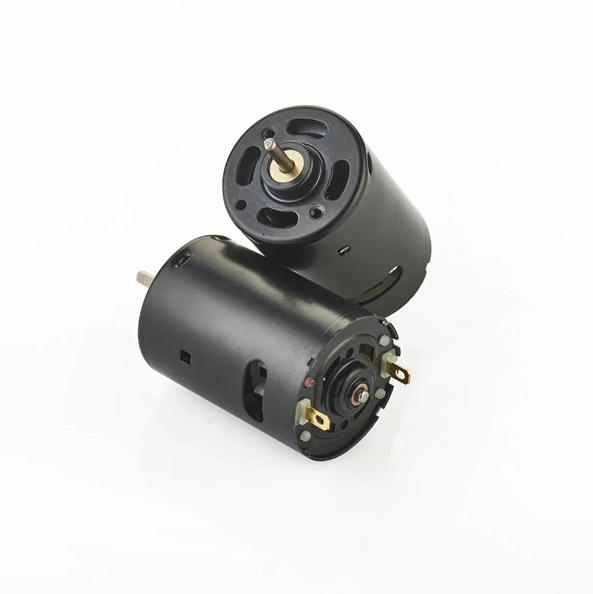
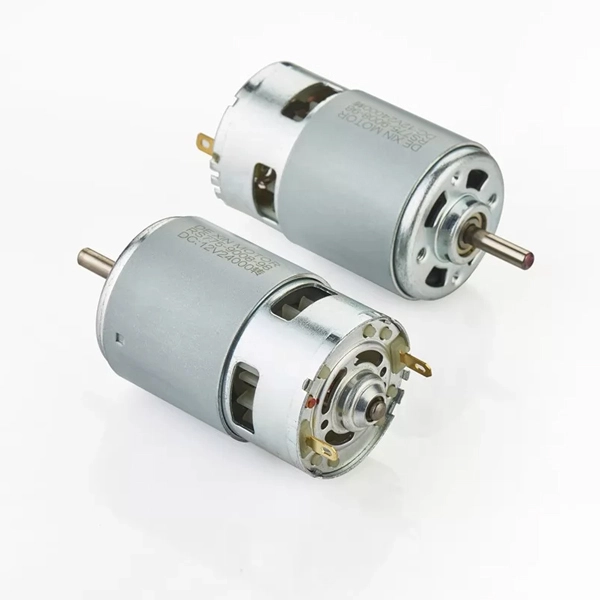
The RS 540 DC Motor is widely recognized as a compact permanent magnet brushed DC motor format. However, RS-540 does not represent one universal specification. Different manufacturers may produce RS 540 motors with different voltage ranges, winding characteristics, speed ratings and torque outputs.
For example, a 12V RS 540 motor designed for high-speed applications may behave very differently from a low-speed, high-torque version. Factors such as armature design, magnet strength, brush structure and internal resistance all influence final performance.
A typical RS 540 DC Motor consists of several key components:
Permanent magnets that create the magnetic field
Armature winding that generates rotational force
Carbon brushes and commutator for mechanical commutation
Shaft and bearings supporting rotation
Because of its relatively simple brushed structure, the RS 540 offers a practical balance between cost, torque output and controllability. MGLORY’s RS540 product line is designed as a compact permanent magnet DC motor solution, with options for different application requirements.
Voltage is one of the most important factors affecting motor speed. In a DC motor, increasing the applied voltage generally allows the motor to reach a higher rotational speed because the electromagnetic force generated inside the motor increases.
However, the actual operating speed of an RS 540 DC Motor is not determined by voltage alone. When the motor is connected to a load, part of the electrical energy is converted into torque output, causing the speed to decrease compared with no-load conditions.
The relationship can be understood as:
Higher voltage → higher potential speed → higher available output range
while:
Higher load → higher current demand → lower operating speed
This is why comparing motors only by no-load RPM can sometimes lead to incorrect selection. A motor that reaches a very high speed without load may not maintain that speed when driving a mechanical system.
For engineering applications, designers usually evaluate:
Operating voltage
No-load speed
Rated speed under load
Current consumption
Thermal performance
A suitable voltage selection allows the RS 540 DC Motor to operate closer to its efficient working range instead of continuously running under excessive stress.
Torque is the key factor that determines whether a motor can move a mechanical load. In a DC motor, torque is directly related to current. When a load increases, the motor requires more current to generate additional electromagnetic force.
The basic relationship is:
More load → More current → Higher torque demand → Lower speed
This relationship explains why an RS 540 DC Motor may slow down when connected to a heavier mechanism.
Mechanical power can be expressed as:
P = T × ω
where:
P represents mechanical power
T represents torque
ω represents angular speed
This means a motor cannot maximize torque and speed at the same time. When torque demand increases, speed normally decreases. The ideal operating point depends on the application requirements.
For example, a small fan may require higher speed but relatively low torque, while a compact vehicle or robotic mechanism may require stronger starting torque. Selecting an RS 540 DC Motor requires understanding which part of the speed-torque curve matches the actual working condition.
The brushed design is one reason why the RS 540 remains widely used in compact motion systems. Unlike brushless motors that rely on electronic controllers for commutation, brushed DC motors use mechanical contact between brushes and a commutator to switch current direction.
The main working process includes:
Current flows through the brushes into the armature winding.
The energized winding interacts with the permanent magnetic field.
Electromagnetic force creates rotation.
The commutator continuously changes current direction to maintain rotation.
This structure provides several practical advantages:
Simple control method
Easy speed adjustment through voltage control
Strong starting torque
Mature manufacturing process
However, because brushes physically contact the commutator, factors such as brush wear, temperature and operating conditions can influence service life. Therefore, application requirements should always be considered when selecting a brushed motor.
The performance of an RS 540 DC Motor changes significantly as the mechanical load changes. The following table shows typical brushed DC motor behavior:
| Operating Condition | Speed | Current Demand | Torque Demand |
|---|---|---|---|
| No or very light load | Highest | Low | Low |
| Moderate load | Reduced | Higher | Higher |
| Heavy load | Further reduced | High | High |
| Near stall condition | Very low | Very high | Peak torque region |
This table represents typical DC motor characteristics, not a specific RS 540 model test result.
During normal operation, the most efficient working area is usually between no-load speed and stall torque. Operating continuously near stall conditions can generate excessive heat because the motor draws high current while producing limited rotational speed.
For this reason, engineers should consider:
Required starting torque
Continuous running time
Cooling conditions
Gear reduction requirements
Available power supply
when selecting an RS 540 DC Motor.
The compact size and balanced performance of the RS 540 make it suitable for many applications requiring reliable rotational power. Common application areas include:
Robotics and educational robot platforms
RC vehicles and model systems
Small pumps and fans
Compact automation mechanisms
Portable equipment
Compared with more complex motion solutions such as servo systems, brushed DC motors can be a practical choice when precise position feedback is not the primary requirement.
For applications requiring higher torque at lower output speed, an RS 540 DC Motor can also be combined with a gearbox. Gear reduction decreases output speed while increasing available torque, allowing the motor to better match mechanical requirements.
MGLORY provides various DC motor solutions, including brushed DC motors, brushless DC motors and customized motor options for different application environments.
The performance of an RS 540 DC Motor depends on the complete relationship between voltage, speed, current, torque and load. A higher RPM rating does not always mean better performance, because the correct motor choice depends on the actual operating condition. By matching motor characteristics with mechanical requirements, engineers can achieve better efficiency, reliability and service life. MGLORY supports customers with RS 540 and other DC motor solutions designed for diverse compact motion applications.
No. RS 540 describes a motor format, but different models may have different voltage ranges, winding designs, speed ratings and torque characteristics.
When mechanical resistance increases, the motor needs more electromagnetic force to maintain rotation. This requires higher current from the power supply.
It depends on the motor specification, load condition, cooling environment and operating cycle. Continuous operation should remain within the motor’s rated limits.
Speed reduction is usually caused by increased mechanical load, voltage drop, temperature rise or operating outside the motor’s efficient range.
Not necessarily. Higher voltage may increase speed capability, but useful output depends on torque demand, efficiency and system matching.
Higher temperature can increase resistance, reduce efficiency and accelerate wear of internal components, especially in brushed DC motors.

 English