


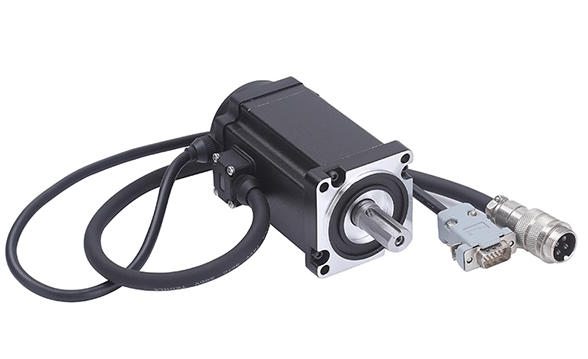
Precision motion control is not achieved by the motor alone. A motor may generate rotation, but accurate positioning, stable speed control and predictable torque response require a complete control system. A Permanent Magnet DC Servo Motor combines permanent magnet motor technology with feedback and controller adjustment to achieve controlled motion performance.
Unlike a standard DC motor that mainly converts electrical energy into mechanical rotation, a Permanent Magnet DC Servo Motor operates as part of a closed-loop system. By continuously monitoring the actual movement and comparing it with the target command, the servo system can correct errors and maintain more accurate operation. This makes it suitable for applications where motion accuracy, response speed and repeatability are important.
A Permanent Magnet DC Servo Motor is a motion control device that combines a permanent magnet DC motor, a feedback system and a controller to achieve accurate and responsive movement. Unlike a conventional DC motor that mainly focuses on continuous rotation, a servo motor operates within a closed-loop control system, allowing it to monitor actual performance and adjust output according to the target command.
The core difference between a DC Servo Motor and a standard DC motor is not simply the use of permanent magnets, because many DC motors already use permanent magnet structures. The key distinction is the integration of feedback control. By continuously collecting information about position, speed or operating conditions, the controller can detect errors between the desired motion and the actual output, then modify the motor input to maintain better accuracy.
In a Permanent Magnet DC Servo Motor, the permanent magnet structure provides the magnetic field required for torque generation, while the feedback and control components determine how precisely that torque is applied. This combination enables more stable motion control in applications such as automation equipment, robotics, precision mechanisms and industrial systems where repeatability and dynamic response are important.
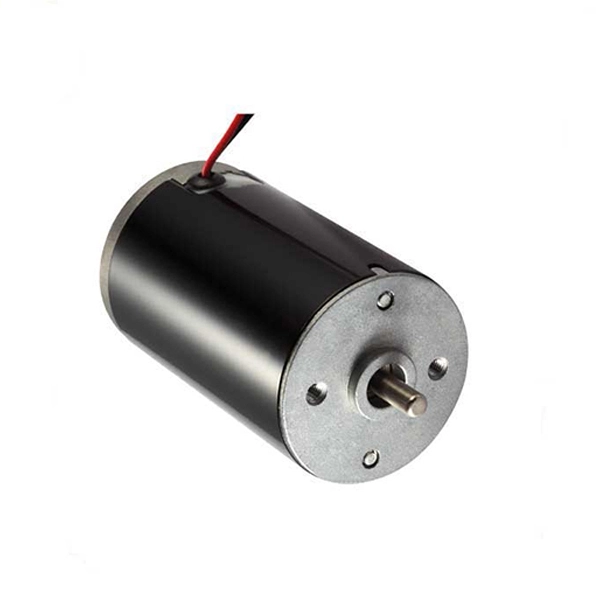
MGLORY provides various DC motor solutions designed for different motion requirements, including permanent magnet motor technologies that support applications requiring reliable performance and efficient power conversion.
The working principle of a permanent magnet motor is based on the interaction between magnetic fields and electric current. Inside the motor, permanent magnets create a stable magnetic field, while current flowing through the armature produces another magnetic field.
When these magnetic fields interact, electromagnetic force is generated, creating rotational torque.
The torque generation process depends on several factors:
Magnetic field strength
Armature current
Motor winding design
Mechanical load conditions
A stronger current generally creates higher electromagnetic torque, but the actual output also depends on motor design and operating conditions.
The permanent magnet structure provides a consistent magnetic field without requiring additional field windings. This allows the motor to maintain a compact design while providing efficient torque production.
However, torque generation alone does not guarantee precise motion. Without feedback, a motor cannot know whether the actual position or speed matches the target value. This is where servo control becomes important.
The most important feature of a Permanent Magnet DC Servo Motor is the feedback loop. Feedback transforms a simple motor into a precision motion system.
The basic control process can be represented as:
Command → Controller → Motor → Load → Feedback → Controller
When a target position or speed is provided, the controller compares the desired value with the actual output measured by the feedback device. If an error exists, the controller adjusts the motor input to correct the difference.
Feedback systems may monitor:
Position
Speed
Current
Torque-related information
For example, if a mechanical load causes the motor speed to decrease, the feedback system detects the change and the controller increases the required current output. This allows the motor to compensate for changing conditions.
This continuous adjustment is why servo systems are widely used in automation equipment, robotics and precision machinery where repeatable motion is required.
A servo system can control different motion characteristics depending on the application requirements. Position, speed and torque control represent three common control approaches.
| Control Mode | Main Objective | Typical Feedback |
|---|---|---|
| Position Control | Reach a target position accurately | Encoder or position sensor |
| Speed Control | Maintain a specific rotational speed | Speed feedback |
| Torque Control | Control rotational force output | Current or torque estimation |
Position control is commonly used when the exact movement location matters. Speed control focuses on maintaining consistent rotation even when the load changes. Torque control is important when the required force output needs to be regulated.
In practical systems, these control methods can also work together. For example, an automated mechanism may require accurate positioning while maintaining a specific torque limit to protect mechanical components.
One of the biggest advantages of a servo system is its ability to respond when operating conditions change.
For example:
Load increases → speed or position error appears → controller responds → current changes → torque increases
When the external load becomes higher, the motor may initially slow down. The feedback system detects this difference between actual and target performance. The controller then adjusts the motor input to restore the desired operating condition.
This response is especially valuable in industrial automation, where mechanical resistance can change during operation.
Factors affecting servo response include:
Load variation
Controller tuning
Feedback accuracy
Motor torque capability
Mechanical transmission design
A correctly matched DC Servo Motor can maintain stable performance even when the working environment is not completely constant.
Although both motor types can provide rotational motion, their control capabilities are different.
| Feature | Conventional DC Motor | PM DC Servo Motor |
|---|---|---|
| Open-loop operation | Common | Possible but not the defining feature |
| Feedback | Not always required | Central to servo operation |
| Position control | Limited without feedback | Strong capability |
| Speed regulation | More affected by load changes | Closed-loop adjustment |
| Control complexity | Lower | Higher |
A conventional DC motor is often suitable for applications where simple rotation is enough. In contrast, a Permanent Magnet DC Servo Motor is designed for situations requiring controlled movement and feedback-based correction.
The additional control system increases complexity, but it also provides much higher precision and adaptability.
A Permanent Magnet DC Servo Motor achieves precise motion through the combination of motor torque, feedback measurement and controller response. The permanent magnet structure provides efficient torque generation, while the closed-loop system enables position, speed and load compensation. MGLORY develops DC motor solutions that support different motion control requirements, helping engineers select suitable motor technologies for automation and precision applications.
Not every servo system uses the same feedback device, but many precision applications use encoders or similar sensors to measure position and speed accurately.
It can physically rotate without feedback, but the defining advantage of servo control comes from closed-loop feedback and error correction.
Mechanical backlash creates a gap between input movement and actual output movement, which can reduce positioning accuracy even when the motor control is precise.
When the required load exceeds available torque, the motor may fail to maintain the target speed or position and may require system protection measures.
Yes. Many servo systems can operate with different control modes, including speed control and position control, depending on the application.
Controller tuning determines how quickly and smoothly the system responds to errors. Proper tuning helps balance response speed, stability and motion accuracy.

 English