


When engineers select a motor for equipment design, the model name alone is rarely enough to determine whether it will meet the application requirements. A DC 380 motor is a good example because the number “380” does not automatically represent a rated voltage. Instead, it may refer to a motor series, frame size or product identification defined by a manufacturer.
To achieve reliable performance, engineers need to evaluate the actual electrical and mechanical characteristics behind the motor, including operating voltage, speed, torque, current and load conditions. Understanding how these parameters interact helps prevent problems such as insufficient torque, overheating or unstable operation.
The term DC 380 motor can sometimes create confusion because users may assume that “380” refers to the operating voltage. However, motor model numbers are usually manufacturer-specific designations and should not be interpreted without checking the technical documentation.
In practical motor selection, the important parameters are not the model number itself but the actual operating specifications, such as rated voltage, no-load speed, rated speed, rated torque, current consumption and mechanical dimensions.
Different motors with similar naming formats may have different performance characteristics depending on:
Motor winding design
Operating voltage range
Magnet configuration
Load requirements
Manufacturer specifications
Therefore, when evaluating a DC 380 motor, engineers should always refer to the datasheet rather than relying only on the product name. The model identification helps locate the correct product, but the electrical and mechanical data determine whether the motor is suitable for the application.
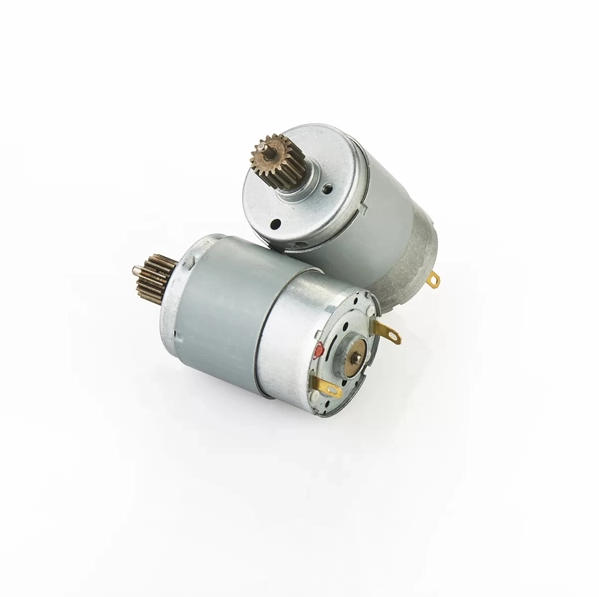
For a DC motor 380, voltage is one of the key factors influencing operating speed. In a brushed DC motor, increasing the applied voltage generally increases the achievable rotational speed because the electrical energy supplied to the motor increases.
However, actual motor speed is not determined by voltage alone. A motor running without load can reach a higher speed, while the same motor connected to a mechanical load will operate at a lower speed because part of the motor’s energy is converted into torque.
The relationship can be understood through several factors:
Rated voltage determines the intended operating range
No-load speed represents motor speed without mechanical resistance
Loaded speed reflects real operating conditions
Back EMF increases as motor speed rises and affects current flow
When the mechanical load increases, the motor must generate more torque. This usually causes higher current consumption and a reduction in speed. Therefore, selecting a motor based only on maximum RPM may result in poor performance in real equipment.
A properly matched DC motor 380 should provide sufficient speed while maintaining stable operation under the expected load.
The relationship between torque and current is one of the most important concepts in DC motor operation. In a typical DC motor, torque generation is closely related to armature current. When the mechanical load increases, the motor requires more torque, which causes current demand to rise.
The basic operating relationship can be described as:
Higher load → Higher torque demand → Higher current → Lower operating speed
Mechanical power is determined by both torque and rotational speed:
P = T × ω
where:
P represents mechanical power
T represents torque
ω represents angular speed
This means a motor operating at high speed with low torque and a motor operating at lower speed with higher torque may deliver similar mechanical power.
For a 380 DC motor, understanding this balance is essential because different applications prioritize different performance factors. A fan system may require continuous speed, while a robotic mechanism may require stronger torque at lower speeds.
A DC motor does not operate with fixed speed and current under all conditions. The mechanical load directly changes the motor’s operating point.
The following table shows typical DC motor behavior. These values represent general operating principles rather than specific test data for a particular motor model.
| Load Condition | Motor Speed | Current | Torque Demand |
|---|---|---|---|
| Light load | Higher | Lower | Low |
| Rated load | Near rated point | Rated region | Normal |
| Heavy load | Lower | Higher | Higher |
| Stall | 0 rpm | Very high | Maximum/stall torque |
When a motor approaches stall conditions, current can increase significantly because the motor is trying to produce maximum torque while rotation is restricted. Continuous operation near stall is usually undesirable because excessive current generates heat and may reduce motor lifetime.
For this reason, engineers selecting a 380 DC motor should consider not only the required operating speed but also the expected load variation during actual use.
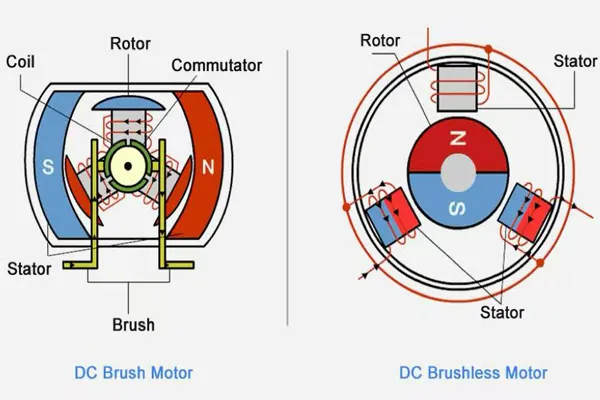
Compact DC motors can use different construction methods, with brushed and brushless designs being two common approaches. The choice between them depends on application requirements rather than one design being universally better.
| Feature | Brushed DC | Brushless DC |
|---|---|---|
| Mechanical brushes | Yes | No |
| Electronic controller | Simpler | Required |
| Brush wear | Possible | No brush wear |
| Maintenance demand | Higher | Generally lower |
Brushed motors use mechanical brushes and a commutator for electrical switching, while brushless motors use electronic control for commutation. This difference affects maintenance, efficiency and control requirements.
For compact motor systems, engineers need to consider operating environment, expected service life, controller availability and cost requirements when choosing the appropriate motor structure.
Selecting a motor should always start from the load rather than the motor name. A practical engineering approach follows a simple sequence:
Load requirement → Required torque → Required speed → Mechanical power → Motor selection → Controller matching
For example, if a machine requires:
Torque: 1 N·m
Speed: 1,500 rpm
The required mechanical power can be estimated using:
P = T × 2πn / 60
The result is approximately:
157 W
This calculation provides a starting point for motor selection. Additional factors such as efficiency, acceleration requirements, duty cycle, operating temperature and available voltage must also be considered.
For manufacturers and equipment developers, choosing the correct DC 380 motor means balancing electrical input with real mechanical performance rather than selecting based on a single specification.
A motor model name provides identification, but it does not replace technical specifications. A DC 380 motor should be evaluated through voltage, speed, torque, current, duty cycle and mechanical requirements. Understanding the relationship between load and motor behavior allows engineers to design more reliable systems. Mglory Motor provides DC motor solutions for different application requirements, helping customers match motor performance with actual operating conditions.
Not necessarily. The number in a motor model usually represents a product series or identification and should be confirmed through the manufacturer’s specifications.
At startup, the motor speed is very low, which reduces back EMF and allows higher current flow to generate starting torque.
No-load speed is measured without mechanical resistance, while rated speed represents operation under a specified load condition.
Continuous operation depends on the motor’s rated voltage, thermal capacity, cooling conditions and application requirements.
Higher loads require more current, and increased current can generate more heat inside the motor.
Engineers should check voltage, speed, torque, current, dimensions, duty cycle and environmental operating conditions before selecting a motor.
This is the first one.
 English