


When selecting the power core for equipment ranging from home appliances to high-end industrial robots, understanding the differences between Brushed DC Motors and Brushless DC Motors (BLDC) is crucial. Although both operate on direct current, their internal construction, control methods, and lifespan performance differ significantly. This guide explores the key distinctions between these two technologies, analyzes why global manufacturing is accelerating the shift toward brushless technology, and helps you find the most suitable solution among numerous DC motor manufacturers in China. Whether you are looking for custom DC motors or DC motor wholesale resources, this article will empower you to make informed decisions.
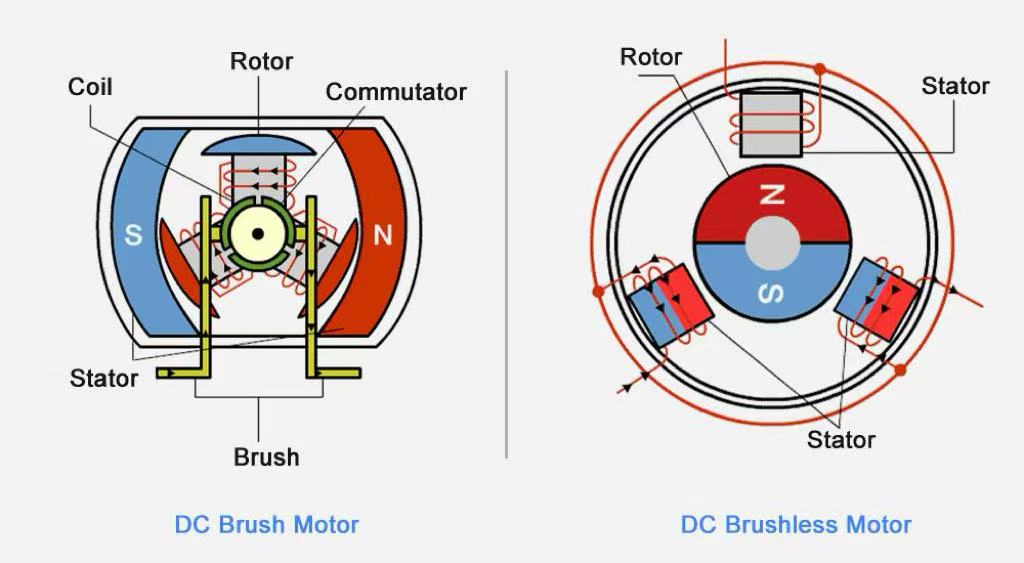
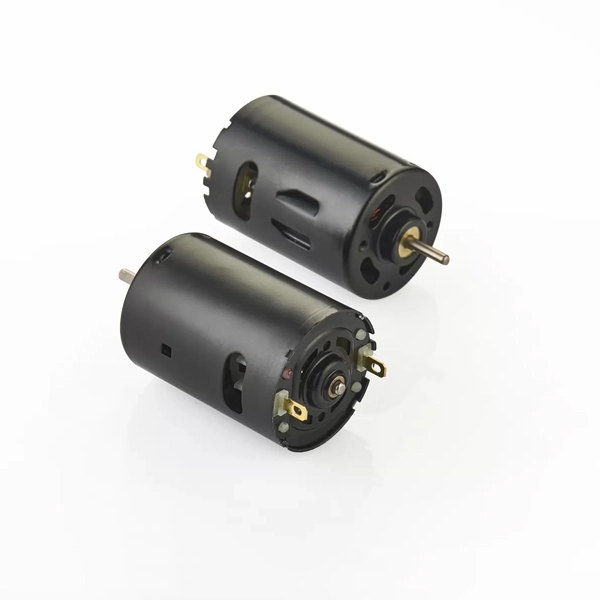
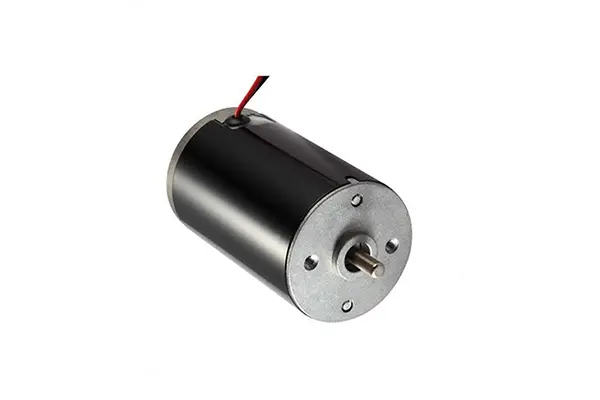
Brushed DC motors are the most traditional and historically significant type of electric motor. They transfer current to the rotating rotor coils via physical contact (carbon brushes and a commutator), generating a magnetic field that drives rotation.
Working Principle: Current flows through carbon brushes into the commutator, reversing the direction of current in the coils to produce continuous torque.
Common Models: Classic series like the RS-380 and RS-550, widely used in cost-effective power tools and toys.
Characteristics: Simple structure, extremely simple control circuit (rotates upon direct power application), and low initial cost.
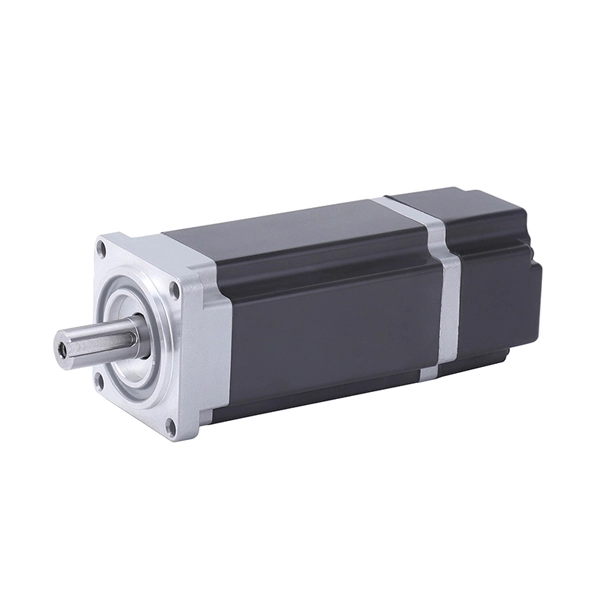
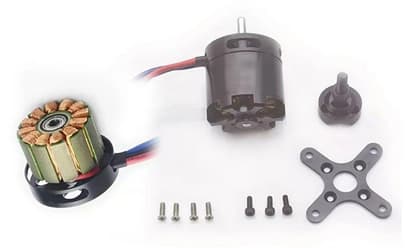
Brushless DC motors eliminate physical brushes and commutators, instead using an electronic controller (driver) to manage current flow to the stator coils, while permanent magnets are located on the rotor.
Working Principle: Hall sensors or Back-EMF detection identify the rotor position, and the electronic controller precisely energizes the stator coils in sequence.
Common Models: Such as BLDC-40mm or Outer Rotor Brushless Motors, widely applied in drones, electric vehicles, and precision medical devices.
Characteristics: No physical wear, high efficiency, low noise, long lifespan, but requires a matching driver.

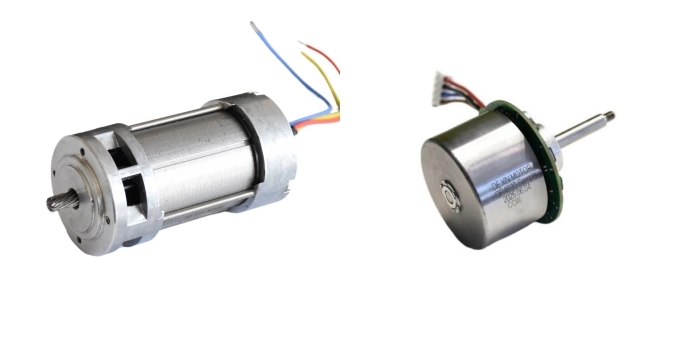
Brushed Motors: Rely on mechanical commutation. Physical friction occurs between carbon brushes and the commutator. Over time, brushes wear down, producing carbon dust, necessitating regular maintenance or replacement.
Brushless Motors: Rely on electronic commutation. Controlled via circuit boards with no physical contact. This completely eliminates spark generation and wear sources, achieving true "maintenance-free" operation.
Brushed Motors: Due to brush friction and contact resistance, energy loss is higher, with efficiency typically ranging from 75% to 80%. Severe heat generation at high speeds limits maximum RPM.
Brushless Motors: Eliminating friction losses allows efficiency to reach 85%-90% or even higher. They offer greater power density and higher rotational speeds in the same volume, with significantly less heat generation.
Brushed Motors: Extremely simple control. Speed is adjusted by changing voltage, and direction is reversed by changing polarity. No additional controller is needed (except for PWM speed control).
Brushless Motors: Complex control. A dedicated Electronic Speed Controller (ESC) is mandatory to coordinate the three-phase current. This increases system cost and wiring complexity but enables precise speed and position control.
Brushed Motors: Friction between brushes and the commutator generates mechanical noise. Electrical sparks during commutation create significant EMI, potentially affecting surrounding sensitive electronics.
Brushless Motors: Operate smoothly and quietly; primary noise sources are bearings and air resistance. The absence of sparks results in minimal EMI, making them ideal for scenarios requiring silence and signal purity (e.g., medical instruments, recording equipment).
Brushed Motors: Lifespan is limited by carbon brushes, typically 1,000 - 3,000 hours. Suitable for intermittent work or low-cost disposable devices.
Brushless Motors: Lifespan is primarily limited by bearings, typically reaching 10,000 - 20,000+ hours. Requires almost no maintenance, ideal for continuous industrial operations.
Advantages:
Low Cost: Both manufacturing and control system costs are the lowest.
Ease of Use: Simple wiring; no programming or complex debugging required.
Good Low-Speed Torque: Provides decent starting torque at low speeds.
Disadvantages:
High Maintenance: Requires regular cleaning of carbon dust and brush replacement.
Lower Efficiency: Higher energy consumption leads to shorter battery life.
Short Lifespan: Unsuitable for long-term, continuous high-intensity operation.
Noise and Sparks: Not suitable for flammable/explosive environments or high-silence requirements.
Advantages:
Ultra-High Efficiency: Significantly extends battery life for portable devices.
Long Lifespan & High Reliability: No wearing parts; adaptable to harsh environments.
High Power Density: Small size and light weight but capable of high output power.
Precise Control: Enables extremely high speed accuracy and dynamic response.
Disadvantages:
Higher Initial Cost: Both the motor itself and the matching driver are more expensive.
Complex Control: Requires professional electronic engineers for system integration and debugging.
Globally, the market share of Brushless DC Motors is expanding rapidly, driven by Chinese manufacturing which is narrowing the cost gap. Key reasons include:
1. Electrification Trend: In Electric Vehicles (EVs) and e-bikes, every watt-hour counts. The high efficiency of BLDC directly translates to longer driving ranges.
2. Intelligence and Automation: Modern robotics and automated production lines require motors with communication capabilities (e.g., data feedback via CAN bus). BLDC motors are naturally suited for integrating intelligent control algorithms.
3. Environmental Regulations: Global energy efficiency standards (such as IE4, IE5 grades) are becoming increasingly strict, making the phase-out of inefficient brushed motors inevitable.
4. Mature Supply Chain: DC motor suppliers in China have significantly reduced the costs of rare-earth magnets and driver chips, making BLDC highly cost-effective even in consumer electronics.
Application Area | Recommended Motor Type | Typical Cases |
Power Tools | Trending towards Brushless | High-end drills, angle grinders (pursuing long endurance and strong power); low-end toys still use brushed. |
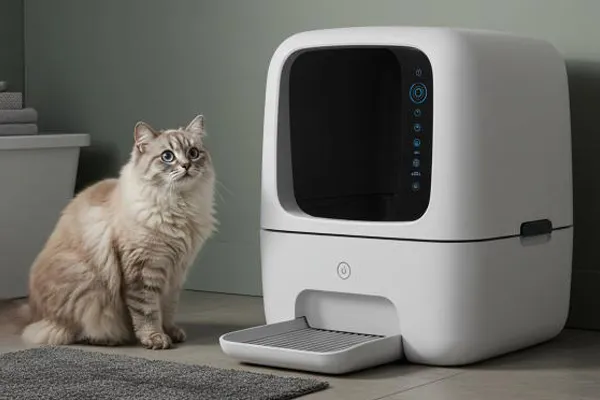
Home Appliances | Mixed | Washing machine direct drive (Brushless), Vacuum cleaners (High-end uses Brushless, low-end uses Brushed), Fans (Brushless for silence). |
Automotive Industry | Primarily Brushless | Electric Power Steering (EPS), AC compressors, Window regulators (gradually replacing brushed with brushless). |
Industrial Automation | Brushless (Servo) | Robotic arm joints, Conveyor belt drives, Precision dispensing machines. |
Consumer Electronics | Micro Brushless | Drone gimbals, Computer cooling fans, Electric toothbrushes. |
Low-Cost Devices | Brushed | Simple toy cars, Disposable medical devices, Simple windshield wipers. |
Before making a decision, ask yourself these three questions:
1. Is the budget extremely sensitive?
If yes, and the product is designed for one-time use or short lifespan, Brushed Motors are the economical choice.
2. Is long lifespan and low maintenance required?
If the equipment is installed in hard-to-reach places or needs to run 24/7 continuously, Brushless Motors are the only reliable option.
3. Are there high requirements for noise, efficiency, and battery endurance?
For handheld devices, medical instruments, or high-end consumer goods, the user experience improvement offered by Brushless Motors far outweighs the added cost.
Expert Advice: If you are developing a new generation of smart products, consider skipping brushed technology entirely and opting for Custom Brushless DC Motors. While the upfront R&D investment is slightly higher, you will gain greater returns in Total Cost of Ownership (TCO) and brand reputation. You can contact professional DC motor wholesalers in China to request samples for testing.
When searching for a reliable motor supplier, NINGBO DEXIN MOTOR is your trusted partner. As a leading DC motor manufacturer, we specialize in providing comprehensive solutions ranging from micro brushed motors to high-performance brushless servo systems.
Customization R&D Capability: Our engineering team can customize RS series brushed motors or high-performance BLDC motors based on your specific requirements (voltage, speed, torque, size), perfectly fitting your product design.
Superior Quality Assurance: All products are certified under the ISO9001 quality management system and comply with international safety standards such as CE, RoHS, and UL, ensuring worry-free exports.
Competitive Pricing: Leveraging China's complete supply chain advantages, we offer the most cost-effective DC motor wholesale prices without compromising on quality.
Fast Delivery & Support: Equipped with modern automated production lines, we deliver samples within 3 days and ensure on-time shipment for bulk orders. We provide one-stop service from selection consulting to after-sales technical support.
Whether you are a startup or a large multinational corporation, NINGBO DEXIN MOTOR provides the power core to drive your future. Contact us today to get a free motor selection scheme and quotation!
 English