


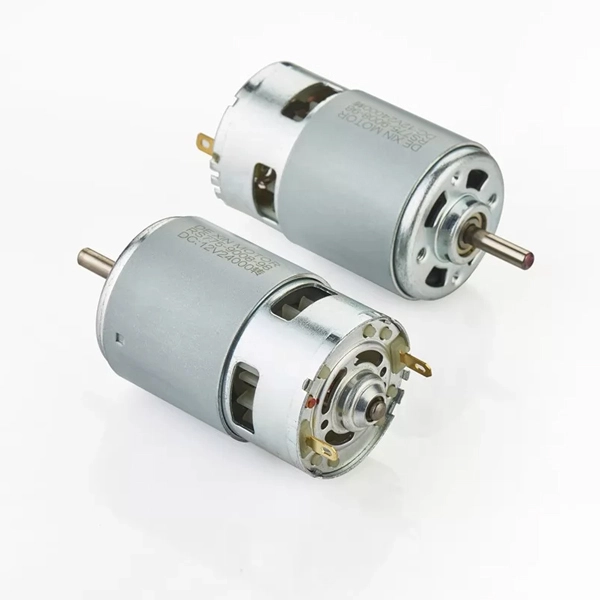
An RS775 is a 42 mm-class permanent-magnet brushed DC motor used when an application needs more power and thermal capacity than smaller RS380, RS540 or RS750 frames. Typical RS775 motor specs include a 42.2 mm body diameter, 66.5 mm motor length, 5 mm shaft, ball bearing, internal cooling fan and bidirectional rotation. Electrical performance is not fixed by the “775” name. Voltage, speed, torque, current and power depend on the winding and load. An OEM project should therefore be selected from a complete performance curve rather than one advertised RPM value.
RS775 motor specifications describe a motor frame and configuration family rather than one universal electrical rating. The following 775 motor specs summarize the MGLORY RS775 brushed DC motor. They support initial packaging and sourcing, but the final winding code and test curve should be confirmed before production.
| Specification | Typical Data | What It Means |
|---|---|---|
| Construction | Permanent-magnet brushed DC | Two-wire drive with carbon-brush commutation |
| Housing diameter | 42.2 mm | Main radial installation envelope |
| Motor length | 66.5 mm | Body length before shaft projection |
| Shaft diameter | 5 mm | Coupling, pinion or pulley interface |
| Bearing | Ball bearing | Supports shaft stability |
| Rotation | CW / CCW | Reversed by changing polarity |
| Cooling | Internal fan | Provides airflow while rotating |
| Approximate weight | 360 g | Relevant to mounting and portable products |
| Configurable voltage | 6–36 V | Winding must match the power supply |
| Configurable speed | 2,000–25,000 rpm | Depends on voltage, winding and load |
| Configurable power | 5–320 W | Must be verified at the working point |
| Running torque range | 30–160 mN·m | Loaded torque should guide selection |
| Stall torque range | 220–1,000 mN·m | Short-duration limit only |
MGLORY lists an SECD steel housing, stainless-steel shaft and internal fan. Customized electrical and mechanical configurations are also available for OEM orders.
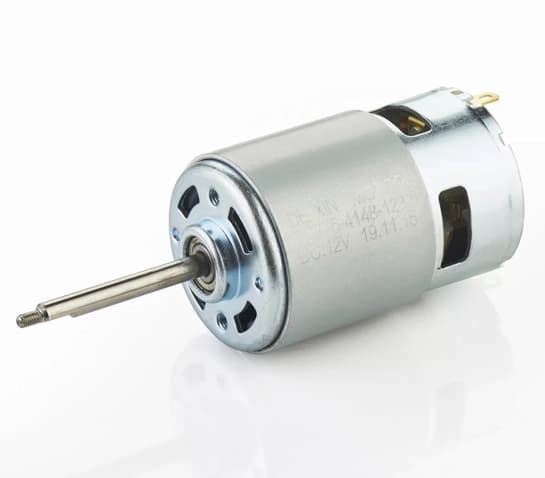
RS 775 motor dimensions determine whether the motor can be mounted, coupled and ventilated correctly. The basic body is 42.2 mm in diameter and 66.5 mm long, with a 5 mm shaft. A complete outline drawing should also confirm the front boss, mounting-hole pattern, shaft extension, terminal position and ventilation clearance. Motors described as “RS775” can share a similar can size while using different shafts, mounting details or end caps. Therefore, the nominal rs 775 dc motor dimensions should not be used as the only basis for designing a finished enclosure.
Before releasing a bracket or housing, check:
Shaft engagement length and coupling alignment
Permitted radial and axial shaft loads
Wire position and minimum bend radius
Clearance around the internal cooling fan
Mounting stiffness under startup torque
Exposure to dust, moisture, fibers or metal particles
A ball bearing improves mechanical support, but it does not eliminate the need to control belt tension, gear mesh or cantilevered loads. The product structure or gearbox should support excessive side loads rather than transferring them entirely to the motor shaft.
An RS775 DC motor datasheet should be read as related no-load, maximum-efficiency and stall operating points. No-load speed is measured with minimal external shaft torque. It helps compare windings, but it is not the actual working speed of a pump, tool or gearbox. No-load current mainly represents internal electrical and mechanical losses. As load torque rises, motor speed normally falls and current increases. The maximum-efficiency point is more useful for preliminary sizing because speed, current, torque, output power and efficiency are stated at the same load point.
MGLORY lists one 18 V reference winding with:
21,000 rpm no-load speed
18,904 rpm at maximum efficiency
131 mN·m torque
259 W output
79% efficiency
A separate 24 V reference winding is listed at 7,000 rpm no load and 5,862 rpm at maximum efficiency, producing 61 mN·m, 37 W output and 72% efficiency.
These examples show why voltage alone cannot predict performance. Different windings can create very different speed and current characteristics inside the same RS775 frame. Because the RS775 is a permanent-magnet brushed DC motor, its brushes and mechanical commutator are subject to wear during operation. Frequent starts, high current, elevated temperature and long duty cycles can affect brush life, so these conditions should be included when evaluating a motor datasheet.
Brushed DC motor speed can be influenced by changing the applied voltage, but current draw, torque demand and temperature must remain within tested limits. Understanding the relationship between voltage, load and DC motor speed regulation helps engineers avoid selecting an RS775 motor only by its advertised no-load RPM.
A useful RS775 motor datasheet should state:
Test and rated voltage
No-load speed and current
Loaded speed, torque and current
Maximum-efficiency operating point
Stall torque and current
Winding resistance
Ambient test temperature
Duty cycle
Rotation direction
Parameter tolerances
Buyers should also request a speed-torque-current curve instead of relying on a single nominal power figure.
RS775 motor selection means matching the required working point, duty cycle and mechanical interface to a tested winding.
| Application | Main Requirement | Recommended Direction |
|---|---|---|
| Power tool | High speed and transient load capacity | RS775 matched to the battery or supply voltage |
| Water pump or electric sprayer | Stable loaded speed and continuous duty | RS775 for higher output; RS750 DC motor for a lighter load |
| Vacuum or blower | High rotational speed with controlled heating | RS775 winding matched to the impeller load curve |
| Grass trimmer | Torque reserve, cooling and contamination control | RS775 with validated thermal margin |
| Compact appliance or hobby system | Lower weight, current and package size | Consider an RS540 DC motor |
| Long-life controlled equipment | Lower brush wear and maintenance | Consider a BLDC-5015 brushless DC motor |
The RS775 is often suited to power tools, pumps, blowers, sprayers, garden equipment and other systems requiring relatively high rotational power from a compact cylindrical motor. The relationships among current, torque, back EMF and rotational speed described in basic brushed DC motor theory explain why the motor should be matched to the real application load rather than selected only because it belongs to a larger frame class.
The following information should be included in a B2B motor inquiry:
Supply or battery voltage
Required speed under load
Continuous and peak torque
Operating time per cycle
Startup frequency
Ambient temperature
Available cooling airflow
Shaft and mounting drawing
Wire and connector requirements
Noise and vibration limits
Estimated annual quantity
A sample that reaches the expected no-load RPM can still overheat or stall in the finished product if loaded current and temperature rise are not verified. The RS750, RS540 and BLDC-5015 pages provide alternative product directions for applications with different package, output and service-life requirements.
The most useful rs 775 dc motor specifications are the values measured at the intended working point. The 42.2 × 66.5 mm frame and 5 mm shaft establish the mechanical starting point, while winding voltage, loaded speed, current, torque, duty cycle and cooling determine reliable performance. Mglory can evaluate custom voltage, speed, shaft, lead wire and connector requirements for MGLORY motor projects. Before mass production, buyers should request an outline drawing, representative performance curve and application-matched samples.
There is no single standard voltage for every RS775 motor. MGLORY lists configurable designs from 6 V to 36 V, but the selected winding must match the equipment supply, required loaded speed and operating duty.
The MGLORY RS775 body is approximately 42.2 mm in diameter and 66.5 mm long, with a 5 mm shaft. Buyers should confirm the full outline drawing because the shaft extension, mounting holes and terminal geometry may vary.
No. No-load RPM is measured with minimal external torque. Working speed will normally be lower after the motor drives a pump, fan, gearbox, cutting mechanism or other mechanical load.
No. Stall is a short-duration condition that can produce very high current and rapid heating. Stall torque should be used for startup and protection calculations, not as a continuous operating target.
Compare the required torque, power, installation space, weight and duty cycle. RS540 suits lighter compact systems, RS750 covers stronger mid-range loads, and RS775 provides a larger frame for higher output and thermal capacity.
Provide the voltage, target speed under load, continuous and peak torque, duty cycle, ambient temperature, shaft and mounting drawing, wire or connector details, rotation direction, noise limits, test requirements and estimated order quantity.
All About Circuits — Understanding DC Motor Operation Modes and Speed Regulation Techniques
Northwestern University Mechatronics Wiki — Brushed DC Motor Theory
 English