


A high speed DC motor for drone propulsion must match the battery voltage, propeller load, required thrust, electronic speed controller and aircraft weight as one system. The highest-RPM motor is not automatically the best choice. A motor that spins too fast for its propeller can draw excessive current and overheat, while a motor with insufficient torque may lose speed during takeoff, wind or payload changes. Most multirotor propulsion systems use brushless DC motors because electronic commutation removes brush wear and supports responsive speed control. Small toy or indoor drones may still use lightweight brushed motors. Mglory supports customized DC and BLDC motor projects, but every flight application should be validated with the actual propeller, battery, ESC and airframe.
A drone motor DC system uses battery-supplied direct current, although a brushless motor’s controller switches that current through multiple phases to create rotation.
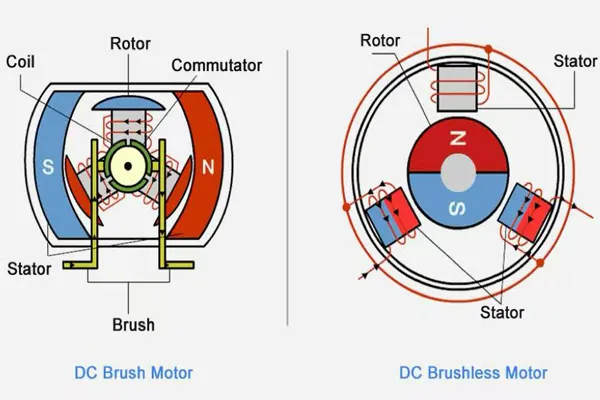
The term may describe two constructions:
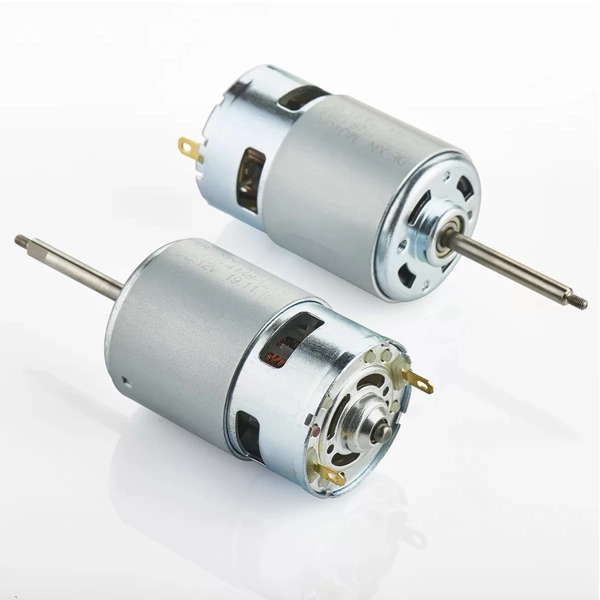
Brushed DC motors use brushes and a commutator. They are simple and economical, which can suit very small drones or short-duty mechanisms.
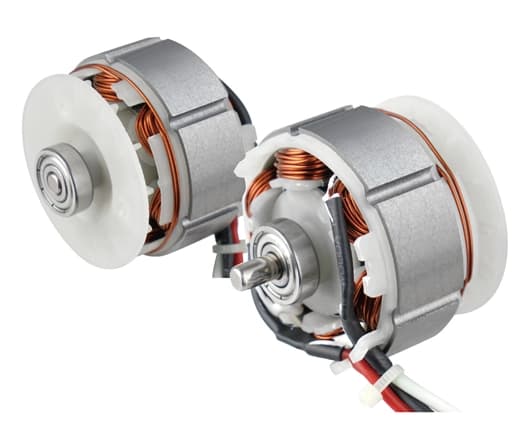
Brushless DC motors use an electronic speed controller for commutation. They are generally preferred for camera drones, FPV aircraft, inspection UAVs and payload platforms.
A two-wire brushed motor can use a relatively simple controller, while a three-phase BLDC motor requires a compatible ESC. Propulsion and auxiliary motion should also be separated. Propeller motors need high power density and fast throttle response. Gimbals, landing gear and release mechanisms may need lower output speed, feedback or a brushless motor gearbox.
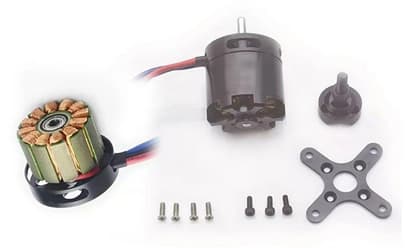
Voltage defines the electrical operating range, while KV indicates the approximate no-load speed produced per volt.
For a BLDC motor:
Approximate no-load RPM = motor KV × applied voltage
A 1,000 KV motor supplied at 12 V would approach 12,000 rpm without a propeller. Actual flight RPM is lower because the propeller creates aerodynamic load.
KV is not a power or quality rating. A higher-KV motor commonly suits a smaller propeller at higher speed, while a lower-KV motor may drive a larger propeller when more torque is required. The correct combination depends on winding design, propeller diameter and pitch, voltage, ESC settings and cooling.
Increasing propeller diameter or pitch increases motor load. A setup that runs safely with one propeller may overheat with another. The Smithsonian’s propeller aerodynamics overview explains how rotating blades produce thrust.
Before selecting a winding, define:
Battery voltage range
Propeller diameter, pitch and blade count
Required hover and maximum RPM
Continuous and peak current limits
ESC compatibility
Maximum motor size and weight
A drone dc motor must produce enough torque to keep the propeller near its required speed without exceeding motor or controller temperature limits. Total thrust must exceed aircraft weight for takeoff, but the required margin depends on payload, wind, altitude, maneuverability and redundancy. For a multirotor, divide the required total thrust across the propulsion motors, then add an engineering margin for control authority and operating conditions. Motor weight is part of the same calculation. A larger motor may provide more torque and heat capacity, but it also increases the thrust needed to carry the aircraft. An undersized motor may remain near its current limit throughout the mission.
Evaluate the complete operating data:
Loaded RPM, not only no-load speed
Continuous and peak torque
Current at hover and maximum load
Efficiency across the flight cycle
Winding, bearing and ESC temperature
Vibration with the selected propeller
The FAA notes that UAS propulsion can use battery-powered electric motors and recommends inspecting motors and propellers when propulsion sound or performance changes. Its UAS propulsion guidance supports treating the motor, propeller and power system as one safety-relevant assembly.
A drone motor selection table should connect the aircraft mission with the motor, propeller and validation priorities.
| Drone Type | Main Requirement | Motor Direction | Validation Priority |
|---|---|---|---|
| Micro indoor drone | Minimum mass and simple electronics | Small brushed DC or miniature BLDC | Weight, startup and battery current |
| Camera quadcopter | Smooth thrust and low vibration | Balanced-KV BLDC | Hover efficiency and vibration |
| FPV or racing drone | Fast acceleration | Higher-speed BLDC with low rotating mass | Peak current and temperature |
| Inspection UAV | Stable continuous operation | Efficient BLDC sized for mission duration | Loaded efficiency and bearing life |
| Payload drone | High thrust and thermal capacity | Lower-KV, higher-torque BLDC | Cooling and payload margin |
| Gimbal or release unit | Controlled low-speed motion | Geared BLDC or brushed gear motor | Backlash and positioning |
A motor DC drone project should pass bench, endurance and aircraft-level tests before its specification is frozen. Use the intended battery, ESC and propeller on a thrust stand. Record voltage, RPM, thrust, current, input power, motor temperature and ESC temperature at several throttle positions. Repeat the test near the battery’s lower operating voltage. Then reproduce the real mission cycle. A brief full-throttle run does not represent a drone that hovers for extended periods or repeatedly lifts a payload. Test warm starts, rapid throttle changes, blocked-propeller protection and cooling inside the final frame.
An OEM inquiry to Mglory should include:
Aircraft type and rotor count
Maximum takeoff weight and payload
Battery voltage range
Propeller dimensions
Required thrust per motor
Target RPM and duty cycle
Continuous and peak current
Motor size and weight limits
Shaft, mounting and connector drawings
Temperature, altitude and ingress conditions
Prototype and annual quantities
Mglory can develop custom dc motors by evaluating winding, shaft, lead wire, connector and other mechanical requirements. Flight suitability must still be confirmed by the drone designer through system-level testing and any applicable safety process.
Most camera, racing and industrial drones use brushless DC motors for propulsion because they provide electronic commutation, responsive control and no brush wear. Small toy drones may use brushed motors when minimum size and low cost are more important.
No. Thrust depends on RPM together with propeller diameter, pitch, blade design and air density. A high-speed motor paired with an oversized propeller may draw excessive current or overheat.
KV is the approximate no-load speed in rpm per volt. It does not mean kilovolts and is not a power rating. Actual RPM falls under
propeller load.
Determine maximum takeoff weight, establish the required total thrust with a suitable flight margin, divide it across four motors, and verify each motor-propeller combination for current, temperature, RPM and efficiency.
It may suit a small brushed mechanism or prototype, but suitability depends on weight, shaft load, speed, cooling and duty cycle. It should not be assumed to replace a purpose-matched BLDC propulsion motor.
Provide battery voltage, propeller size, required thrust, target RPM, current limits, duty cycle, maximum motor weight, mounting dimensions, connector requirements, operating environment and order quantity.
 English